cee-exporter
Dell PowerStore CEPA audit events → Windows EventLog / GELF / Syslog / Beats / .evtx
cee-exporter is a lightweight Go daemon that receives Dell PowerStore file-system audit events via the CEPA (Common Event Publishing Agent) HTTP protocol and forwards them to a SIEM or writes them as native Windows Event Log entries.
Protocol note: The CEPA client sends events over plain HTTP only. Always register the
http://URL in PowerStore — neverhttps://. See Operator Guide.
Quick links
- Operator Guide — installation, configuration, TLS, CEPA registration
- GitHub repository
- CHANGELOG
- Releases & binaries
- Docker image
What it looks like running
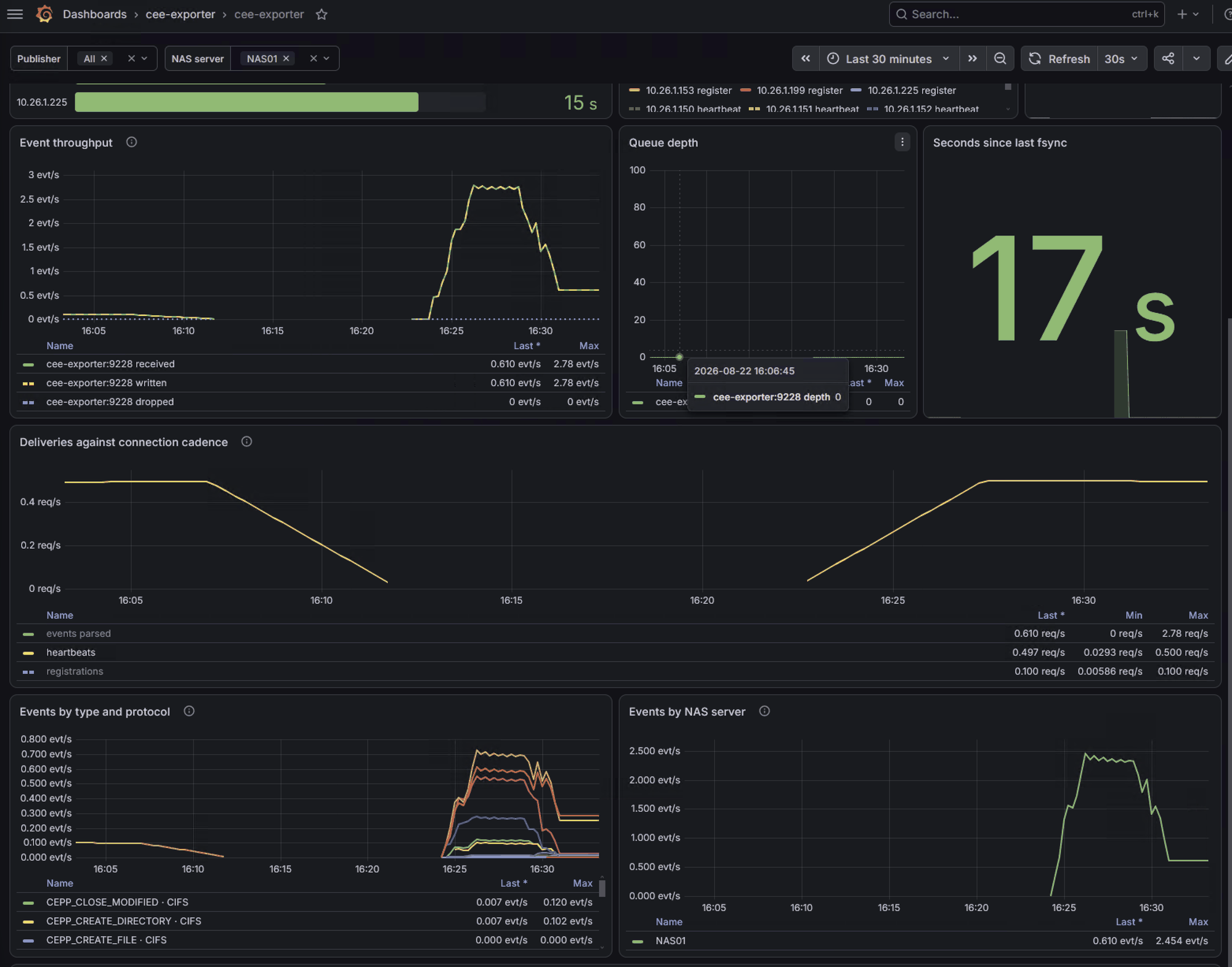
The bundled dashboard (dashboards/cee-exporter.json) against a live estate —
Grafana 11.5.1, 2026-08-22. Click for full resolution; the panel-by-panel
reading, and what the capture does not prove, is in the
operator guide.
Architecture overview (v2)
flowchart TD
    PS["Dell PowerStore\n(CEPA HTTP PUT — plain HTTP only)"]
    Prom["Prometheus\n(scrape :9228/metrics)"]

    subgraph server["pkg/server — :12228"]
        H["CEPA Handler\nRegisterRequest handshake\nHeartbeat ACK < 3 s"]
        HH["HealthHandler\nGET /health"]
    end

    subgraph metrics_srv[":9228"]
        MH["MetricsHandler\nGET /metrics"]
    end

    subgraph proc["Processing"]
        P["pkg/parser\nCEE XML → []CEPAEvent"]
        M["pkg/mapper\nCEPAEvent → WindowsEvent\n(EventID, access mask)"]
    end

    Q["pkg/queue\nAsync worker pool\n(capacity + workers)"]

    subgraph writers["pkg/evtx — Writers"]
        GW["GELFWriter\nUDP / TCP\nAll platforms"]
        WW["Win32Writer\nApplication EventLog\nWindows only"]
        MW["MultiWriter\nfan-out to ≥1 backend"]
        SW["SyslogWriter\nRFC 5424 UDP / TCP\nAll platforms"]
        BW["BeatsWriter\nLumberjack v2 ± TLS\nAll platforms"]
        EW["BinaryEvtxWriter\nNative .evtx files\nNon-Windows only"]
    end

    subgraph svc["Platform service"]
        SL["systemd unit\nLinux"]
        SW2["Windows SCM\nkardianos/service"]
    end

    PS -->|HTTP only| H
    H --> P
    P --> M
    M --> Q
    Q --> GW & WW & MW & SW & BW & EW
    Q --> MH
    Prom --> MH
    SL -.manages.-> server
    SW2 -.manages.-> server
Key properties
| Property | Value |
|---|---|
| Listen port (CEPA) | 12228/TCP (configurable) |
| Listen port (metrics) | 9228/TCP (configurable) |
| Default output | GELF UDP → localhost:12201 |
| Binary size | ~11.5 MB (stripped, CGO_ENABLED=0, linux/amd64 — 12,099,746 bytes measured on the released v5.3.1 artifact, 2026-08-11; grown from an earlier ~6 MB as dependencies were added) |
| Dependencies | CGO disabled on every platform; the Linux binaries are fully static (no NEEDED entries — asserted on every push and every tag). The macOS binaries link the system libSystem/CoreFoundation/Security libraries, as every Go binary on macOS does |
| Platforms | Linux and macOS on amd64 and arm64; Windows on amd64 (see table below) |
| Go version | 1.27.2 |
Supported platforms
| Platform | Architectures | Release artifact |
|---|---|---|
| Linux | amd64, arm64 | tar.gz |
| Windows | amd64 | zip |
| macOS | amd64, arm64 | tar.gz |
This table describes the next release. The currently downloadable
v4.1.3 predates the change and still includes a windows_arm64 zip.
Windows on ARM64 was removed from the GoReleaser build matrix deliberately. The exporter runs on a server receiving events from a PowerStore array, Windows Server does not ship for ARM64, and no CI runner exists to test it — so the artifact was published every release without ever being executed.
The Win32 EventLog writer (evtx on Windows) is Windows-only. SIGHUP-triggered
EVTX rotation (see Operator Guide)
is non-Windows only — the signal does not exist on Windows, so the handler is
compiled out there.
Output writers
| Type | Description | Platform |
|---|---|---|
gelf |
GELF 1.1 JSON over UDP or TCP → Graylog | All |
evtx |
Win32 EventLog API on Windows (real event descriptions via a compiled message resource — see Windows Verification Protocol); native .evtx files on all other platforms |
All |
syslog |
RFC 5424 structured syslog over UDP or TCP | All |
beats |
Lumberjack v2 to Logstash / Graylog Beats Input (± TLS) | All |
multi |
Fan-out to any combination of the above | All |
Documentation
- Operator Guide — installation, all config fields, TLS setup, CEPA registration, troubleshooting
- Windows Verification Protocol — manual Event Viewer verification for the Win32 writer's message rendering and registration upgrade path
- Product Requirements (PRD) — problem statement, goals, personas, v2 requirements
- v2.0 Research Notes — technology stack decisions, pitfalls, CEPA protocol findings
- Research Archive — full phase-by-phase research (stack, architecture, pitfalls, code examples)
- Architecture Decision Records:
- ADR-001 — Go as implementation language
- ADR-002 — GELF as primary Linux output
- ADR-003 — Async queue for CEPA ACK timing
- ADR-004 — BinaryEvtxWriter deferred to v2
- ADR-005 — CGO disabled for static linking
- ADR-006 — Prometheus on port 9228
- ADR-007 — ~~x/sys direct~~ (superseded)
- ADR-008 — crewjam/rfc5424 for SyslogWriter
- ADR-009 — BinaryEvtxWriter from scratch
- ADR-010 — kardianos/service for Windows SCM
- ADR-011 — Four-mode TLS (off/manual/acme/self-signed)
- ADR-012 — Flush ticker ownership inside BinaryEvtxWriter
- ADR-013 — Write-on-close model
- ADR-014 — go-evtx extracted to its own module
- ADR-015 — Windows message resource compiled into the binary
- ADR-016 — Three-oracle EVTX read-back verification
- ADR-017 — Register with CEE under an allowlisted partner identity